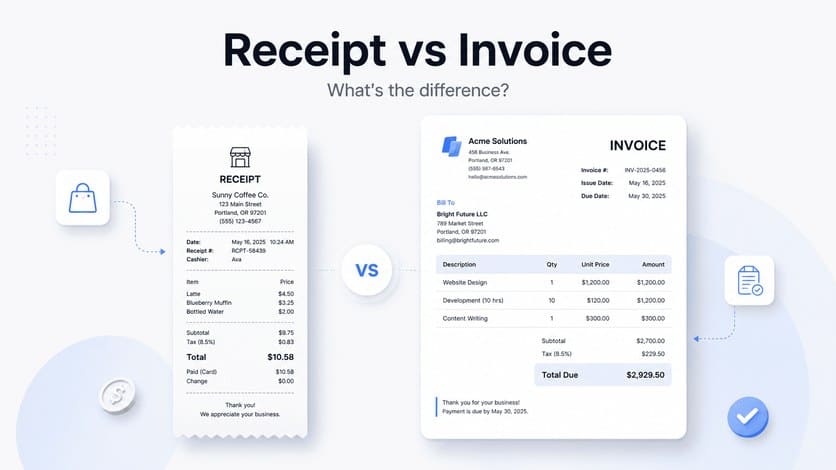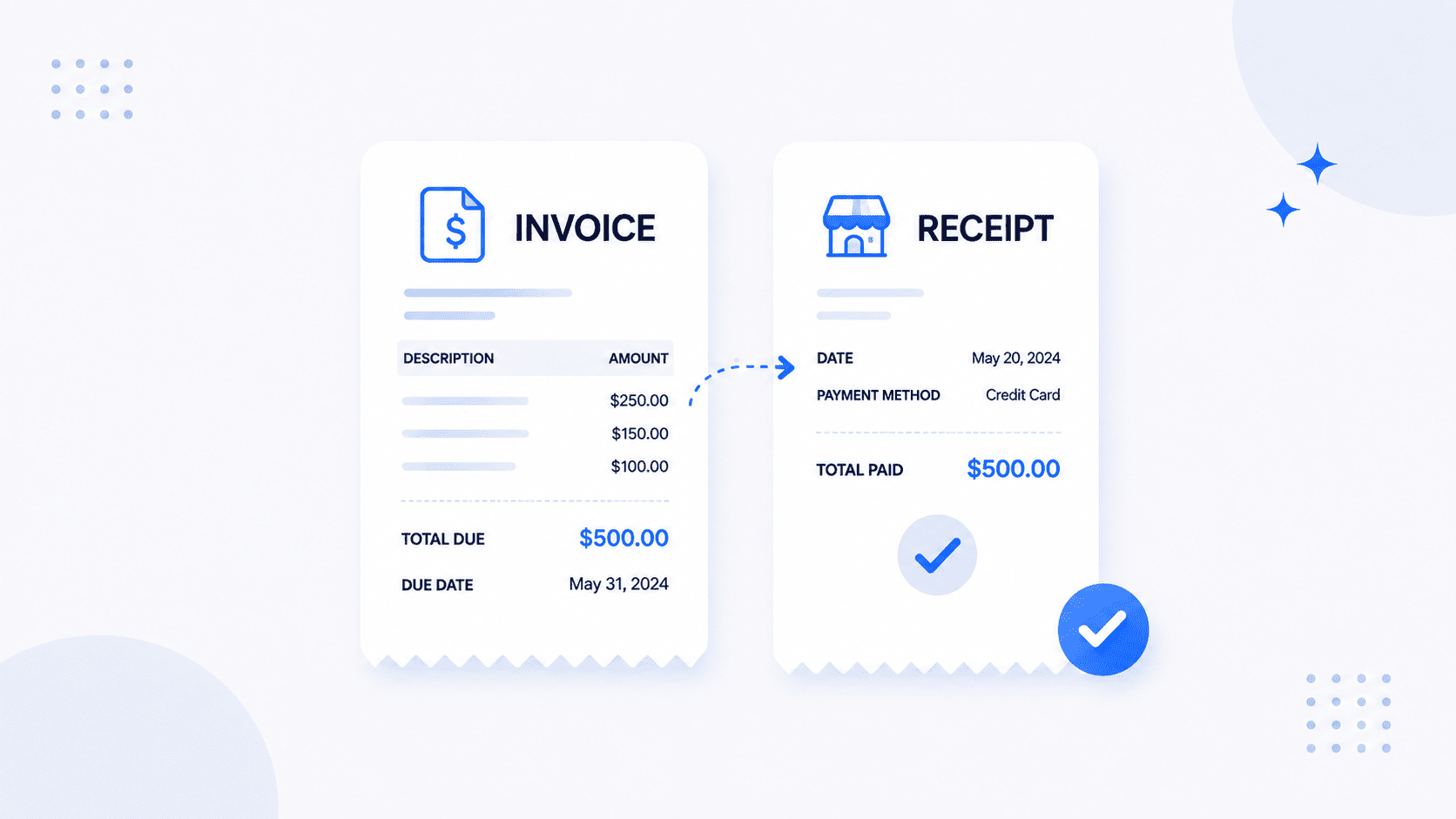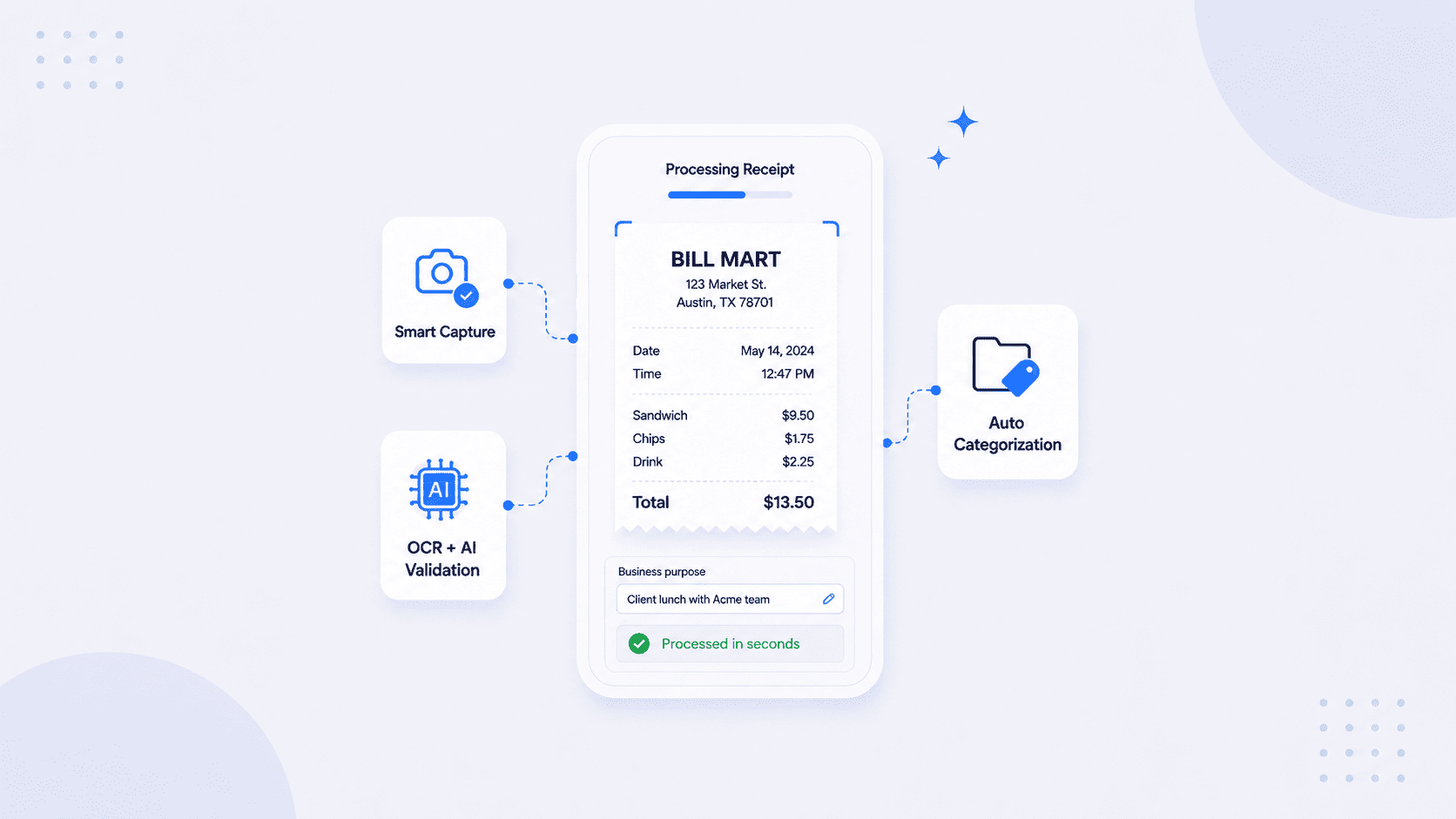
The IRS burden of proof - why this matters more than you think
When you claim a business deduction, to prove it is legitimate is entirely your responsibility. Publication 463 calls this the burden of proof. What the IRS needs from you is proof that expenses were real. You will need to provide so-called "documentary evidence" which proves that all your numbers are real. Without them, even a completely legitimate expense becomes very hard to defend.
Common mistakes to avoid
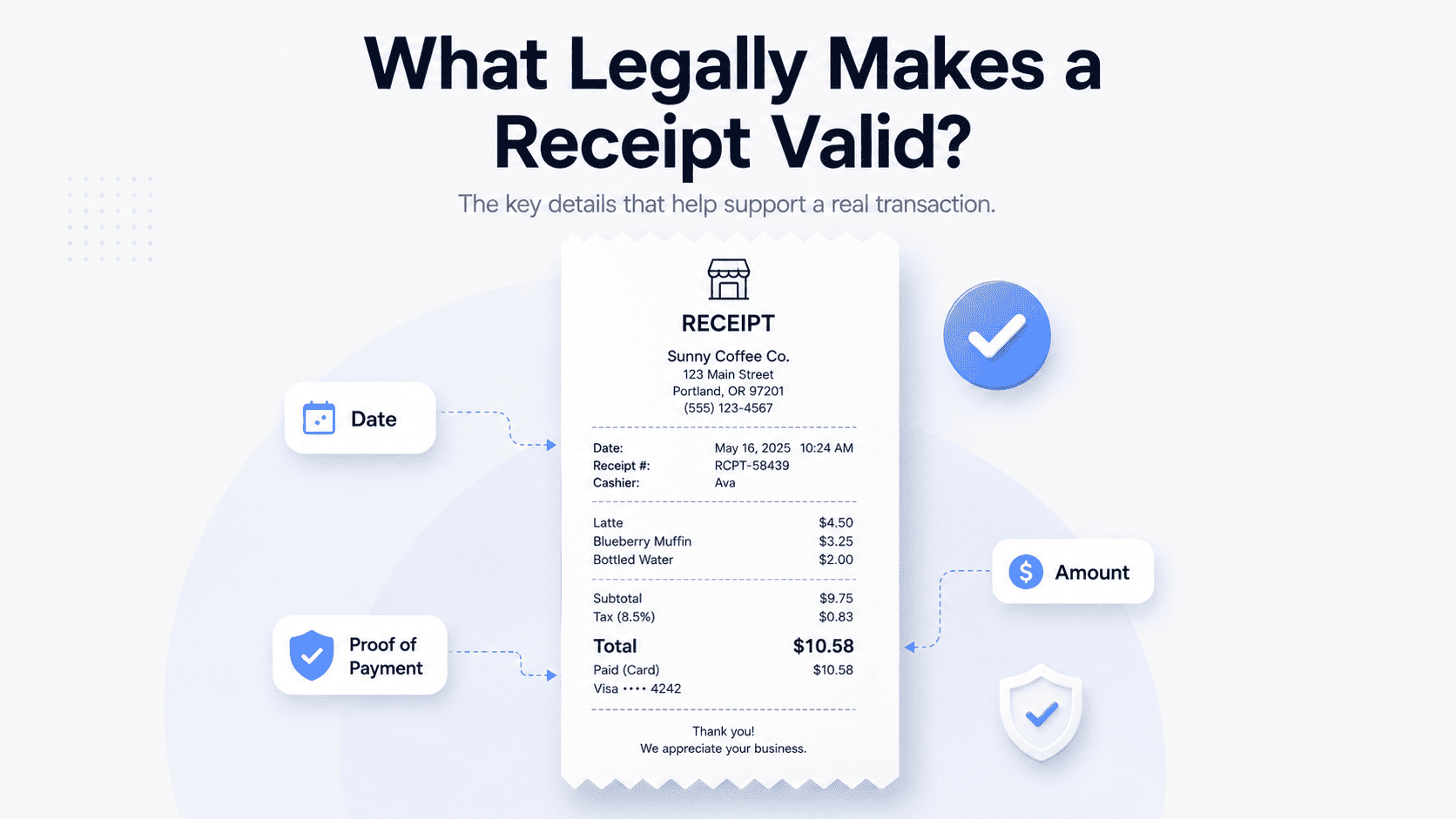
While the IRS doesn't provide a universal receipt template, there are several details your records should clearly show if you ever need to support a deduction:
Vendor name - the name of the business or service provider you paid. A receipt without a seller's identification is not useful to an auditor; Date of transaction - the exact date the purchase was made, not the date the receipt was printed or processed; Amount paid - the total amount of the transaction including any taxes or fees. Description of goods or services - what was actually purchased. A receipt showing only a total amount with no itemization can appear questionable; Proof that payment was made - confirmation that transaction actually happened, not just that payment was requested;
The more information your records contain, the easier it becomes to support the expense if questions arise later.
The one thing a receipt can never prove on its own
There is a detail that might catch business owners off guard. Even though a receipt shows that a transaction happened, it doesn’t automatically prove that the expense qualifies as a business deduction.
Under IRC Section 162, a business expense generally needs to be ordinary and necessary to qualify as deductible. A receipt helps prove that the expense occurred, but it is still your responsibility to show how it relates to your business. Publication 463 provides detailed guidance on business expenses such as travel, meals, gifts, and transportation, including what records should be kept to support those deductions.
Even though this might sound a bit frightening, the proof can be as simple as a note added at the time of purchase in your accounting software or a log entry made the same day. This small step helps connect the receipt to its business purpose and makes it much easier to support the expense later if questions arise.
The $75 rule
There is one exception that surprises a lot of business owners. In certain situations, the IRS allows expenses under $75 to be substantiated without a receipt, although lodging expenses generally still require supporting records regardless of the amount.
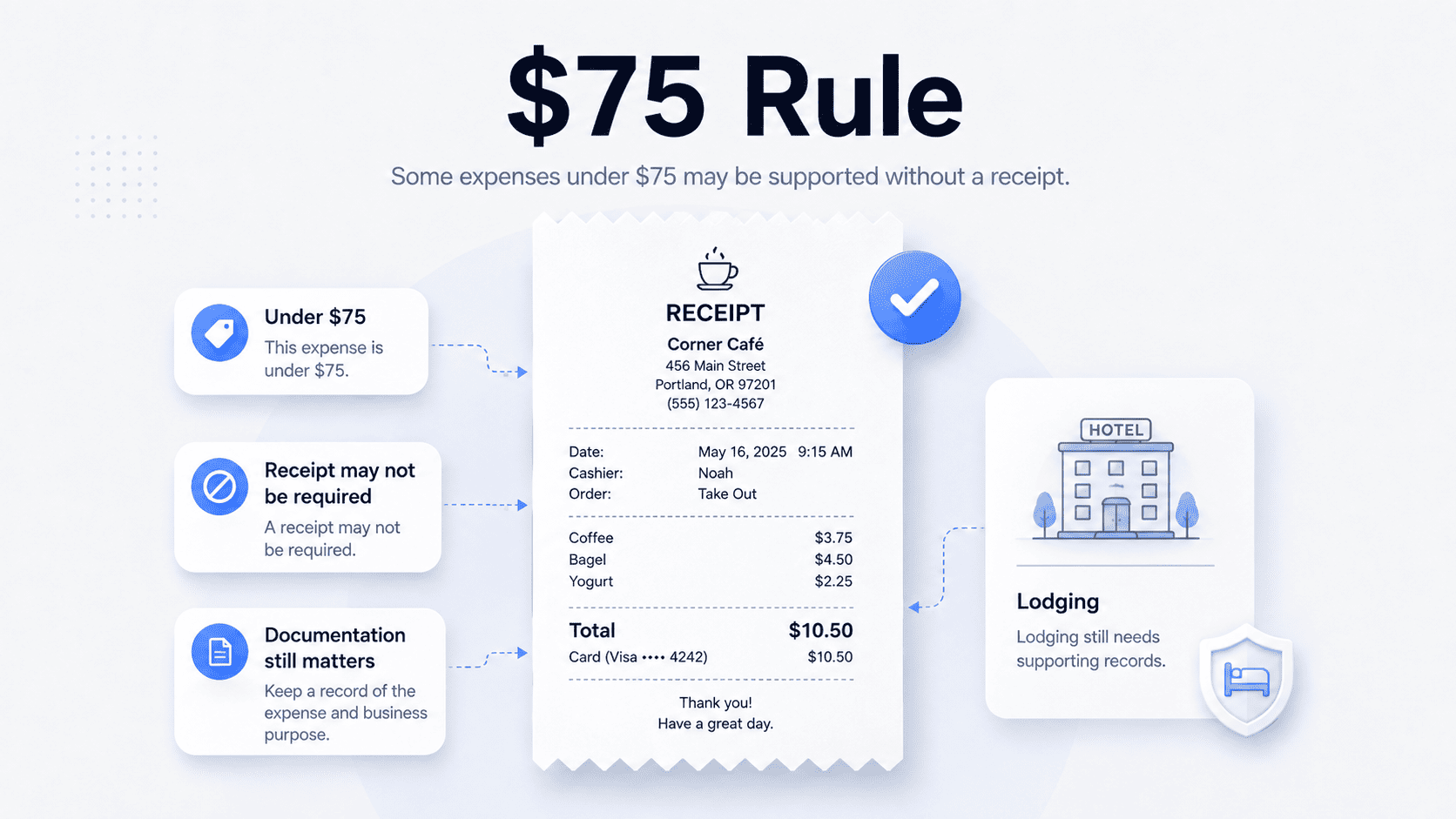
That doesn't mean the expense can go without documentation at all. You should still be able to show when the expense occurred, how much was spent, and how it relates to your business. Credit card statements, bank records, accounting entries, and other supporting documentation may help provide those details when a receipt is unavailable.
What the $75 rule does not remove is the documentation requirement. The receipt may not be required, but proof of the expense and its business purpose still is. One important detail to remember - this threshold applies to individual transactions, not the total amount.
Three categories the IRS watches most closely
There are three expense categories where the IRS pays extra attention - meals, travel, and vehicle expenses. The reason is simple: these are the most common areas where personal expenses end up claimed as business deductions.
For meals, just having a receipt from a restaurant is not enough. The IRS will also look for documents about who was at the meal, when it took place, and what the business purpose was.
Same works with travels. Documentation is needed for transportation, accommodation, and the business purpose of the trip.
For vehicle expenses, a mileage log is one of the most important records. Each entry should document the date, destination, business purpose, and miles driven. If you're using the standard mileage method, keeping an accurate log is essential.
Paper vs digital and why digital is actually the safer choice
Since 1997 the IRS has accepted digital records as legally equivalent to paper originals. Scanned receipts, phone photos, PDFs and email confirmations can all be used as supporting documentation as long as they are legible, accessible when needed, and have not been altered.
The practical reason to go digital immediately is something most people find out too late. Most store receipts are printed on thermal paper - the shiny kind you get at gas stations and restaurants. It is chemically designed to fade. Leave it in a wallet or folder for a couple of years and there is a good chance it becomes an unreadable blank strip. A faded receipt can make it much harder to support a deduction if questions arise later. A digital photo taken the same day can help preserve that record for years to come.
Losing a receipt does not automatically mean that a deduction becomes impossible, but it can make it much harder to support. There is something called the Cohan Rule - a tax court case that allows expenses to be reconstructed when records are genuinely lost, using things like bank statements, credit card records, and transaction histories.
A receipt photographed at the time of purchase will usually provide stronger support than records pieced together months later. The Cohan Rule can help when things go wrong, but it should be treated as a backup rather than a recordkeeping strategy.
How long to keep receipts?
Three years after filing is the baseline - that is the standard window the IRS has to audit a return. Several situations extend that window, and for business assets the rules work differently entirely.
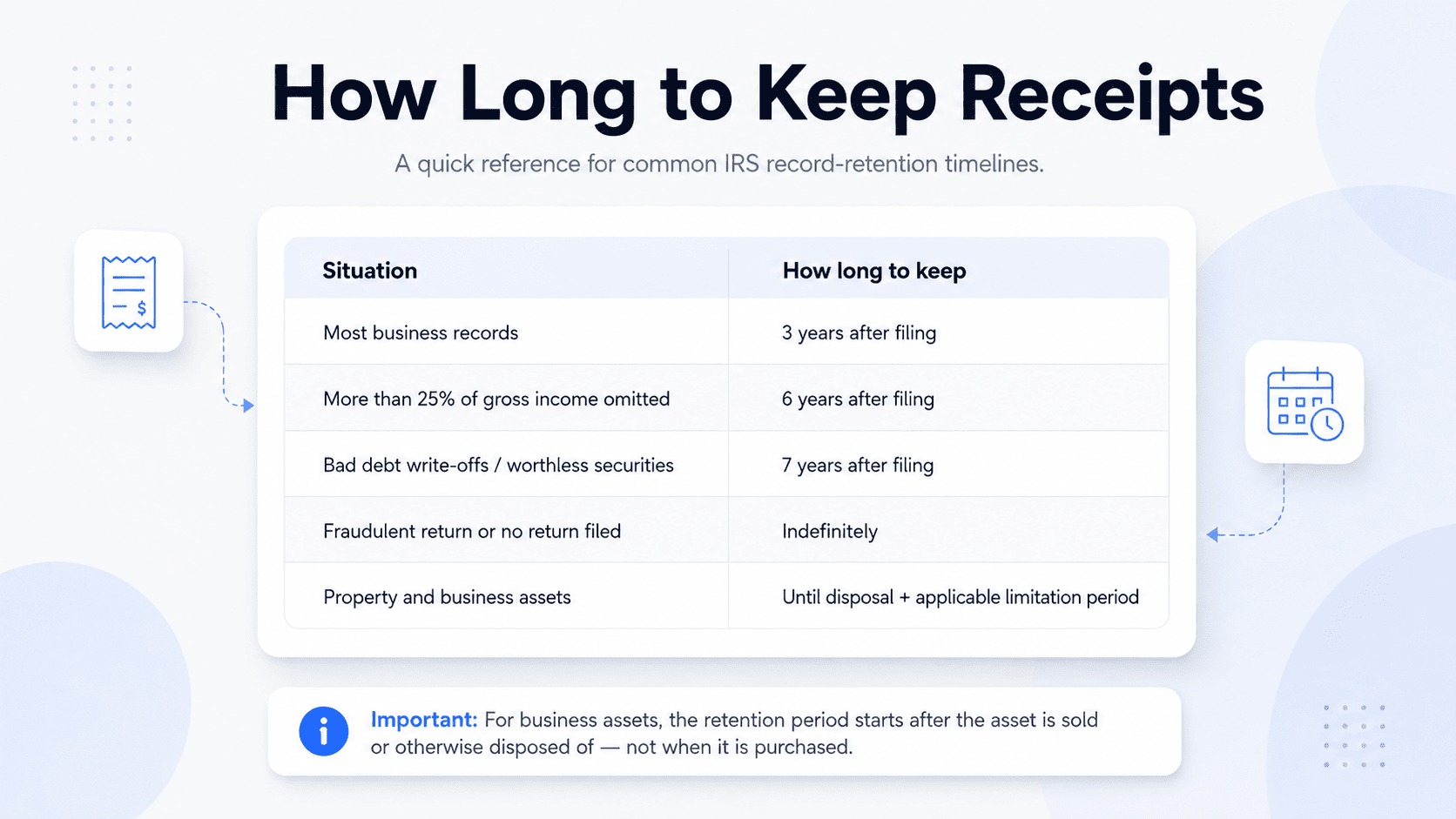
One thing worth remembering about business assets: the retention period doesn't start when you buy the asset. It starts after the asset is sold or otherwise disposed of. That's why records related to equipment, property, and other business assets often need to be kept much longer than ordinary receipts.