Issue a receipt when the payment is received
If a business follows a simple rule of issuing a receipt after every payment, it becomes much easier to maintain accurate records, even if the IRS doesn't specifically require it. This system makes it easier for both businesses and customers to track when the payment happened, how much was paid, and who made the transaction.
Which payments should receive a receipt?
One thing worth knowing is that a receipt can be issued not only after a full payment is made.
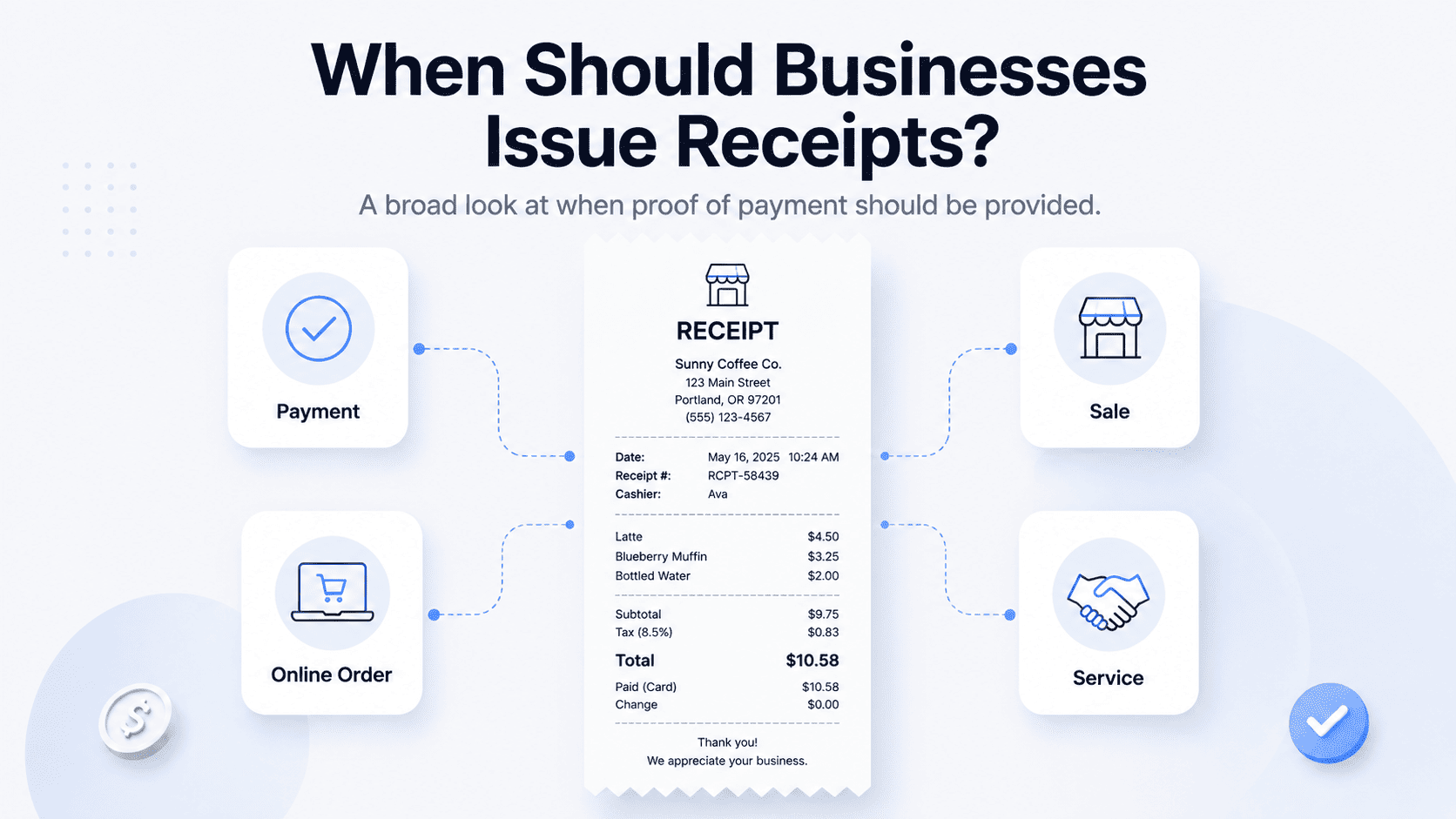
A business can issue a receipt when a client makes:
Full payment Partial payment Deposit Final installment payment
It means that if one service requires multiple transactions then a receipt for each transaction can be issued to keep a record of it. It becomes especially important for businesses that collect payments in stages rather than all at once.
Can receipts be digital?
Since the IRS accepts paper and electronic receipts - both are suitable to capture this record of payment. It is important that this document should have the information contained in the original document and would be accessible when needed. So if you are scanning your receipts and keeping them in digital form - that is a suitable option, even if you don’t keep the original paper form. Usually it’s even safer to keep records digitally, because paper receipts might fade during the time and the important information might become unreadable.
Should receipts be issued for cash payments?
Paying by cash and having a record of this payment requires extra attention. The receipt becomes especially important because it may be the only documentation proving that the payment happened. When you pay by card, bank transfer, or an online payment platform, there is usually another record showing that the transaction happened. With cash payments, a receipt may be the only record available.
In this case, receipt is important not only for business but for customers as well, because if months later any questions will arise, without the receipt there is no other proof of that payment.
Other documents that count as proof of payment
A receipt is one of the most common ways to prove that a payment was made, but it is not the only one. Bank statements, credit card records, payment processor confirmations, and accounting software records can also help document a transaction.
The reason these documents are not always enough is that they often lack the same level of detail. The receipt usually includes information about what was purchased, when the payment was made, who made it, and who received it. A bank statement usually won't show all of these details, which is why a receipt often becomes the most useful record of the transaction.
To sum up
Receipts are not the most exciting part of running a business, but they become important when you need to prove that a payment was made. It doesn't matter whether the payment comes from a customer or goes out as a business expense - having a receipt makes it much easier to track what happened and when. What the IRS mainly cares about is accurate recordkeeping, and receipts are one of the easiest ways to do that. They help avoid confusion, support your bookkeeping, and give businesses and customers proof if questions come up months or even years later.